
 Depending on the continent and climate zone, natural fibers grow all year round. The dependence on local and global weather influences changes the quality and quantity of the fibers at the time of harvest or during and after cleaning and processing.
Geopolitical or regional events are other factors affecting the availability of natural fibers. In the case of statistical evaluations, it must be taken into account that some regional harvest periods also take place at the turn of the year.
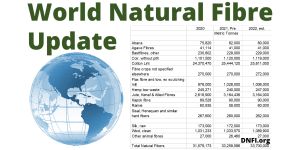
World natural fibre production is estimated at 32.8 million tonnes in 2026, essentially unchanged from the preliminary 32.9 million in 2025.
Jute production is estimated to have fallen to a two-decade low in 2025 due to adverse weather during the harvest period. Meanwhile, world wool production fell to its lowest level in a century as farmers shifted to meat breeds. The USDA estimates cotton production at 26.5 million tonnes, the highest in eight seasons. Coir production is expected to reach 1.1 million tonnes, while the total production of all other fibres is expected to reach 2.2 million tonnes.
Over the last two decades, the production of natural fibres has fluctuated between 27.8 and 34.9 million tonnes, with no discernible upward trend. Production of coir, other fibres not elsewhere classified (NEC), flax and hemp has increased, while production of abaca, kapok, silk and wool has declined.
Excerpt from the 15 page report August 2026 (+ 24 graphs and 3 tables):
…. As of early August 2026, the Government of Bangladesh was still regulating exports through a system of conditional allotments, resulting in significant …. India first imposed anti-dumping duties ranging from $19 to $ …. Quotes for Brent Crude jumped 21% between the end of June and the end of …. USTR announced that Bangladesh, Indonesia, Cambodia and Malaysia would receive tariff rate quotas (TRQ) for a volume of specific textile and …. According to IndexBox, 'The World Bast Fibers market is undergoing a structural transformation as industrial demand for renewable, lightweight, and low-carbon materials reshapes …. The DNFI estimate of world abaca production in 2026 is just 48,000 tonnes, while the estimate for 2025 is …. The Fibral Material Alliance (FIBRAL) estimates that world pineapple fibre production reached 1,000 tonnes in 2025, and banana fibre reached …. Export prices of coir, fob Indonesia, rose to $0.22/kg in …. The International Cotton Advisory Committee (ICAC, an intergovernmental organization) is estimating 2026/27 world cotton production at 25.9 …. production of flax for textile applications is estimated at 410,000 tonnes in …. World ramie production peaked in the …. World jute production dropped to a two-decade low during …. World silk production is estimated at 101,000 tonnes in 2025 and 105,000 in …. Prices of Brazilian sisal, Bahia, Type 3 DB, FOB Salvador were quoted at US$ …. The Australian Eastern Market Indicator (EMI) dropped 7% in USD terms during …. The Freightos Index, Global, an indicator of world average 40' container freight rates, rose 6% in July …. DNFI application periode for the Innovation in Natural Fibres Award 2026 ends on 30 September ….
Free Download of the 15 page report: “DNFI World Natural Fibre Update August 2026”
Please note the download link send to you will automatically expire after 7 days.
DNFI members can access previous reports here: https://dnfi.org/dnfi-world-natural-fibre-updates/
The DNFI World Natural Fibre Update is provided by: Dr. Terry Townsend, DNFI Statistics and Data Analysis Expert.
Related Posts