
 Depending on the continent and climate zone, natural fibers grow all year round. The dependence on local and global weather influences changes the quality and quantity of the fibers at the time of harvest or during and after cleaning and processing.
Geopolitical or regional events are other factors affecting the availability of natural fibers. In the case of statistical evaluations, it must be taken into account that some regional harvest periods also take place at the turn of the year.
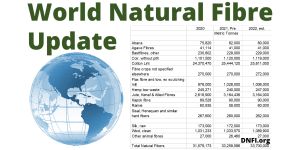
World natural fibre production is estimated at 33.2 million tonnes in 2026, 300,000 tonnes greater than the preliminary estimate for 2025.
In 2025, Jute production is estimated to have fallen to a two-decade low because of adverse weather during the harvest period, and world wool production fell to the lowest mark in a century as farmers shifted to meat breeds. Cotton production is estimated by USDA at 26.6 million tonnes, the highest in eight seasons. Coir production is estimated at 1.1 million tonnes, and production of all other fibres together is estimated at 2.2 million tonnes in 2025.
For 2026, the world total for natural fibre production includes a sharp increase in jute production partially offsetting a decline in cotton production. Jute prices were record high through July 2026, and early reports indicated increased plantings and good initial weather in 2026. Assuming above-average yields linked to good weather and increased input use, jute production is forecast to rise to 3.3 million tonnes.
Excerpt from the 12 page report September 2026 (+ 22 graphs and 3 tables):
…. cotton production in 2026 is forecast by USDA at 25.6 million tonnes, a decline of 0.9 million tonnes from …. The DNFI estimate of world abaca production in 2026 is 51,000 …. world pineapple fibre production reached 1,000 tonnes in 2025, and banana fibre reached …. Coir production is trending upward. However, …. World cotton production in 2026/27 (August-July) is forecast by USDA at …. Cotton futures rose 13% in August to finish
the month at $ …. October 7 is World Cotton Day, established on the Calendar of the United Nations General Assembly. World Cotton Day 2026 will be hosted officially in Tashkent, Uzbekistan, …. Eflax long fibres converted to
USD fell to $6.76 by …. Area harvested for hemp grown in the open for fiber in the United States was estimated at 8,779 hectares, up 14 percent from …. India imposes anti-dumping duties ranging from $19 to $352 per ton on …. Jute quotes in August averaged US$1.38/kg, 38% higher than …. Prices of silk (grade 3A; Denier 20/22D; regain 11%) in China were about US$ …. The sisal growing area of Bahia, Brazil, is currently suffering a severe …. World wool production in 2025 is estimated at less than …. little changed in August at $13.25 per kg, but the British Fleece Price Indicator, converted to USD, dropped …. DNFI application periode for the Innovation in Natural Fibres Award 2026 ends on 30 September ….
Free Download of the 12 page report: “DNFI World Natural Fibre Update September 2026”
Please note the download link send to you will automatically expire after 7 days.
DNFI members can access previous reports here: https://dnfi.org/dnfi-world-natural-fibre-updates/
The DNFI World Natural Fibre Update is provided by: Dr. Terry Townsend, DNFI Statistics and Data Analysis Expert.
Related Posts