
 Depending on the continent and climate zone, natural fibers grow all year round. The dependence on local and global weather influences changes the quality and quantity of the fibers at the time of harvest or during and after cleaning and processing.
Geopolitical or regional events are other factors affecting the availability of natural fibers. In the case of statistical evaluations, it must be taken into account that some regional harvest periods also take place at the turn of the year.
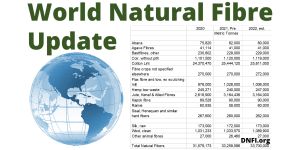
World natural fibre production is forecast at 33.1 million tonnes in 2026, down marginally from the preliminary 33.3 million in 2025. In 2025, Jute production is estimated to have fallen to a two-decade low because of adverse weather during the harvest period, and world wool production fell to the lowest mark in a century as farmers shifted to meat breeds. Cotton production is estimated by USDA at 26.7 million tonnes, the highest in eight seasons. Coir production is estimated at 1.1 million tonnes, and production of all other fibres together is estimated at 2.3 million tonnes in 2025..
For 2026, the world total for natural fibre production is forecast down marginally from 2025. However, the total includes a sharp increase in jute production partially offsetting a decline in cotton production. Jute prices are currently record high, and early reports indicate increased plantings and good initial weather in 2026. With average yields, jute production could rise to 3.5 million tonnes. In contrast, cotton production in 2026 is forecast by USDA at 25.3 million tonnes, a decline of 1.4 million tonnes from 2025. Declines in cotton prices since peaking during the Covid era are discouraging cotton production and encouraging shifts to rotation crops such as maize, soybeans and wheat.
Excerpt from the 15 page report June 2026 (+ 23 graphs and 4 tables):
…. The government of Bangladesh banned exports of jute in September 2025, but gave approval in April 2026 to …. Jute prices are 140% higher than one year ago, and in May a kg of jute was worth 14% more than a kg of …. In Nepal, jute mills are currently facing a severe …. British Wool prices rose to the highest level in a decade during …. During May, fine Merino types (16.5 to 19 micrometres) had another …. Under Section 301 of the Trade Act (yet another tariff provision in US law), the United States will impose tariffs of …. The Freightos Index, Global, an indicator of world average container freight rates, rose …. Polyester yarn in China, 32 count, single, white, virgin material, grade 1, (directly competitive with spun cotton yarn) fell to …. Export prices for abaca, grade S2, Free on Board (FOB) Manila, have been stepping …. India exported coir products, including pith, worth US$600 million in …. The International Cotton Advisory Committee (ICAC, an intergovernmental organization) is estimating 2026/27 world cotton production at 25.7 …. The Government of India removed an 11% duty on …. Prices of textile flax long fibres converted to USD rose …. In 2025, production of hemp grown in the open for fiber was estimated at …. The MFA expired at the end of 2004, and ramie production has since dropped to …. World sisal production is forecast at 330,000 tonnes in …. Prices of Brazilian sisal, Bahia, Type 3 DB, FOB Salvador were quoted at US$ …. DNFI application periode for the Innovation in Natural Fibres Award 2026 will start shortly ….
Free Download of the 15 page report: “DNFI World Natural Fibre Update June 2026”
Please note the download link send to you will automatically expire after 7 days.
DNFI members can access previous reports here: https://dnfi.org/dnfi-world-natural-fibre-updates/
The DNFI World Natural Fibre Update is provided by: Dr. Terry Townsend, DNFI Statistics and Data Analysis Expert.
Related Posts